W
Wizidoo
Back to blog
11 min read

Active Recall: The #1 Technique for Memorization

Active Recall: The #1 Technique for Memorization

# Active Recall: The #1 Technique for Long-Term Memorization

Re-reading notes is the most common study method among students. It is also one of the least effective. Active recall is its direct opposite and its demonstrated superior: instead of passively reading information, you attempt to retrieve it from memory, without looking at it. This seemingly minor difference produces measurable and massive effects on long-term retention.

The good news: active recall does not require more time than re-reading. It requires a different kind of effort — one that actually translates into durable learning.


What Is Active Recall?

Active recall (also known as retrieval practice) means attempting to retrieve information stored in memory without having it in front of you at the moment of retrieval.

It is a simple definition, but it changes everything. Compare:

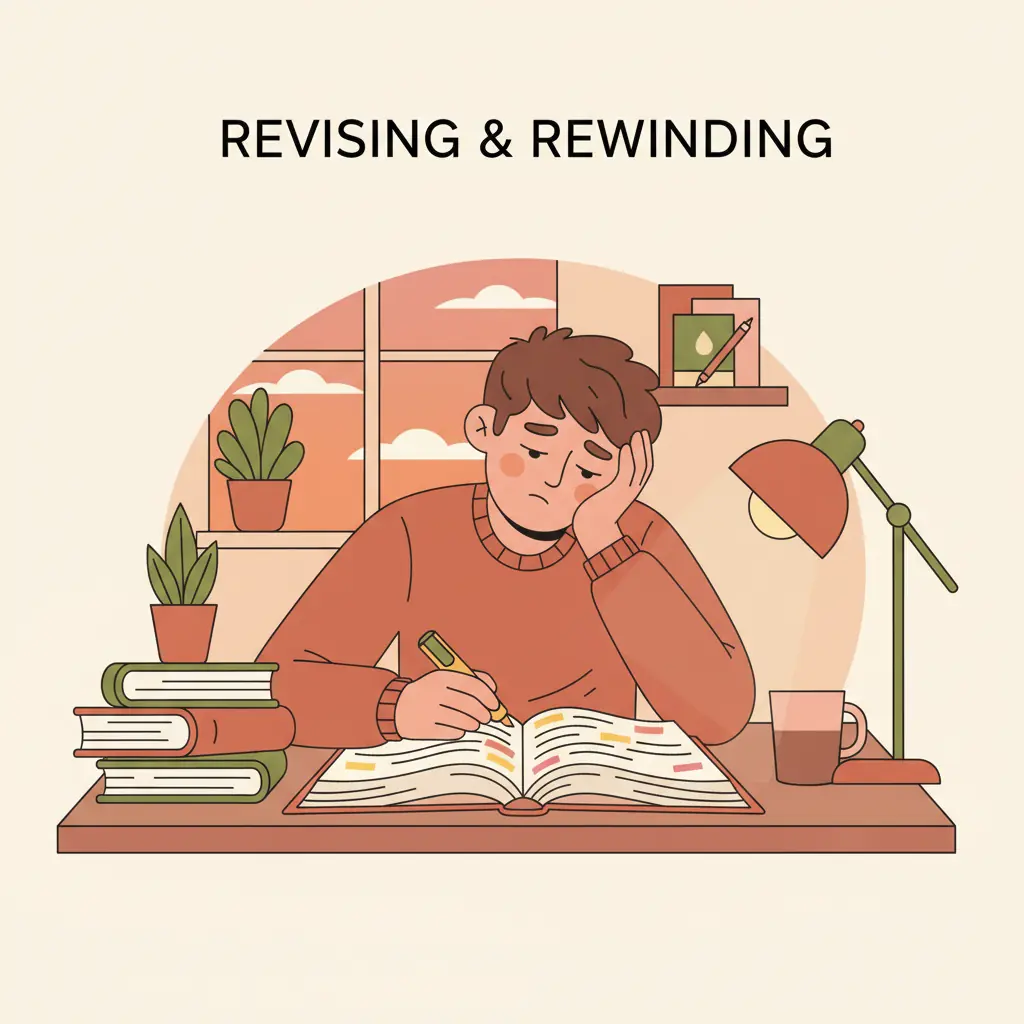
  • Passive re-reading: you open your notes on photosynthesis and read the page. The information enters through your eyes. It feels familiar. You have the impression you know it.
  • Active recall: you close your notes and write down everything you know about photosynthesis. Where you get stuck, you have identified a real gap.

The distinction is fundamental: in the first case, you recognize information you can see. In the second, you reconstruct it from your memory. These two cognitive operations do not have the same effect on retention.

Active recall is not a variant of traditional revision. It is a distinct learning mechanism that acts directly on the neural pathways activated during retrieval. Every retrieval attempt — even an unsuccessful one — measurably strengthens memory traces.


The Testing Effect: What the Science Says

The superiority of active recall over re-reading is one of the most robust findings in cognitive psychology. Researchers call it the testing effect or retrieval practice effect.

The landmark study was conducted by Henry Roediger and Jeffrey Karpicke (2006), published in Psychological Science. Their protocol: students read a scientific passage, then were divided into three groups.

  • Group 1: re-read the passage four times.
  • Group 2: read once, then self-test three times (free recall without looking at the text).
  • Group 3: read once, self-test once.

Results on a retention test one week later:

  • Group 1 (re-read ×4): 40% retention.
  • Group 2 (test ×3): 61% retention.
  • Group 3 (test ×1): intermediate results.

The gap is more than 50% in favor of the group that self-tested. And that is not the most striking finding: in the immediate test right after studying (five minutes later), the re-reading group was slightly better. It is at one week that the gap grows dramatically. Re-reading produces short-term memorization; active recall builds long-term retention (Roediger & Karpicke, 2006).

John Dunlosky and colleagues (2013) conducted the most comprehensive meta-analysis on learning strategies, reviewing decades of research. Of ten techniques evaluated, retrieval practice received the highest utility rating across all contexts — science or humanities, young or adult learners, short or long study durations. Re-reading and highlighting ranked at the bottom (Dunlosky et al., 2013).

Nathaniel Kornell and Robert Bjork (2007) showed that even failed retrieval attempts produce a learning benefit superior to re-reading — what researchers call the hypercorrection effect: corrected errors are better retained than information never forgotten (Kornell & Bjork, 2007).


Why Re-Reading Creates an Illusion of Mastery

If re-reading is so ineffective, why do students continue to use it so heavily? The answer lies in a well-documented cognitive bias: the fluency bias.

Robert Bjork (UCLA) formalized this mechanism in his work on desirable difficulties (Bjork & Bjork, 2011). When you re-read a text you have already seen, reading goes smoothly, without friction. The brain interprets this fluency as a signal of mastery: "I read this easily, so I must know it well."

This is a category error. Reading fluency measures familiarity with the text, not the ability to retrieve the information. Recognizing information when it is in front of you and retrieving it from memory are two different skills.

This illusion is dangerous precisely because it is comfortable. Re-reading produces a sense of productivity without producing its effect. The student finishes the study session convinced they have worked hard, because everything felt familiar. During the exam, facing a blank page, they discover they cannot reproduce what they thought they knew.

Active recall produces the opposite effect: it is uncomfortable when practiced — precisely because it requires a genuine retrieval effort. But that effort is exactly what consolidates the memory trace.


4 Concrete Forms of Active Recall

Active recall is not a single technique. It is a family of practices that share the same principle: close the notes and attempt to retrieve.

1. Flashcards

This is the most structured form. One side holds the question or concept. The other side holds the answer. The work consists of seeing the question, attempting to answer mentally, then checking. Errors are noted and reviewed more frequently. Correct answers are progressively spaced out.

Flashcards are particularly effective when combined with spaced repetition (see next section). They work for any content that can be formulated as a question/answer pair: definitions, formulas, vocabulary, dates, laws, biological mechanisms.

2. Practice Quizzes

After reading a chapter or attending a lecture, submit yourself to a series of questions on the content — without looking at your notes. Past exam papers are a natural form of quiz. End-of-chapter questions in textbooks are another.

Quizzes can be done alone (by inventing your own questions) or with tools that automatically generate questions from your notes.

3. Brain Dump (Blank Sheet Method)

Close your notes entirely. Take a blank sheet of paper. Write down everything you know about a topic, with no imposed order — as a list, diagram, or free text. This technique is particularly powerful for identifying grey areas: where the pen stops is where the gap is.

The brain dump is less precise than a quiz (it does not point to a specific question) but it activates broader retrieval and helps build structured representations of knowledge.

4. Explaining to Someone

Or pretending to. The Feynman Technique (named after physicist Richard Feynman) rests on this principle: if you cannot explain a concept simply to someone who does not know it, you have not truly understood it.

The exercise involves imagining yourself explaining the concept to a younger student, without technical jargon. The parts where the explanation becomes vague or circular reveal exactly the gaps to fill.


How to Combine Active Recall and Spaced Repetition

Active recall and spaced repetition are two distinct techniques, but their combination produces results superior to either one taken alone.

Spaced repetition exploits the forgetting curve described by Hermann Ebbinghaus (1885): without revision, we forget roughly 70% of information within 24 hours of learning it. The optimal strategy is to review information just before forgetting it — at increasing intervals.

Nicolas Cepeda and colleagues (2006) confirmed in a meta-analysis of 254 studies that spaced practice is significantly superior to massed practice, regardless of the delay between learning and the final test (Cepeda et al., 2006).

The SRS (Spaced Repetition System) operationalizes these principles. Its logic is straightforward:

  • You answer a flashcard correctly → it reappears in a few days.
  • You get it wrong → it reappears tomorrow.
  • Intervals progressively lengthen for well-retained items: 1 day → 3 days → 1 week → 2 weeks → 1 month.

The cumulative effect is substantial: information reviewed five times at optimal intervals is retained far more durably than information reviewed twenty times in a single massed session. And each review is an active recall session — both effects reinforce each other.


Putting It Into Practice: Turn Your Notes Into a Quiz in 3 Steps

Here is a concrete protocol you can apply today to any subject.

Step 1 — Active first read. Read the material once, pen in hand. For each important concept, rephrase it in the margin in one sentence. Do not highlight — rephrase. Rephrasing is already a first act of active recall (the generation effect, demonstrated by Slamecka & Graf, 1978).

Step 2 — Convert to questions. Close the material. On a separate sheet or in a dedicated app, transform each key point into a question. "Photosynthesis uses light to convert CO2 into glucose" becomes: "What is the role of light in photosynthesis?" or "What is converted, into what, using what?"

Step 3 — Test and space. Answer your questions without looking at the material. Check. Note the errors. Review the errors the next day. For correct answers, set a reminder for three days. Repeat with increasing intervals.

This protocol takes roughly twice as long as a simple re-read during the first session — but subsequent reviews are much shorter, and retention is incomparably better over the long term.


Common Mistakes to Avoid in Active Recall

Even when practiced, active recall can be poorly executed. Some frequent pitfalls:

Looking at the answer too quickly. If the answer does not come in ten seconds, some students immediately check the notes. This is counterproductive: the search effort — even an unsuccessful one — is part of the training. Give retrieval time to happen, even if it is difficult. Kornell and Bjork showed that unsuccessful retrieval attempts increase subsequent memorization, provided the correction follows immediately (Kornell & Bjork, 2007).

Making quizzes too easy. If you answer everything correctly, you are not learning — you are confirming what you already knew. Increase the difficulty: rephrase questions differently, add application questions rather than simple definitions, mix chapters.

Never correcting mistakes. Getting something wrong is only useful if you understand why and revisit the point. An uncorrected error is a gap that becomes fixed. After every quiz session, systematically go through incorrect answers with the material open — then re-test yourself on those points within 24 hours.

Stopping when it becomes uncomfortable. Active recall is difficult by design. The feeling of difficulty is not a warning signal — it is proof the mechanism is working. Robert Bjork calls these desirable difficulties: strategies that are hard in the moment are precisely the ones that produce the most durable learning.


Expected Results: A Realistic Timeline

Two questions come up often: how long does it take to see results, and how measurable is the improvement?

The first week. From the very first active recall sessions, you will observe something uncomfortable: you do not know as much as you thought you did. The gaps that re-reading was masking become visible. This is a positive signal, not a negative one — you are finally measuring your actual level.

At two weeks. Items you have tested yourself on multiple times begin to consolidate. Retrieval becomes faster, more fluent. You start to perceive the difference between items truly memorized and those not yet sufficiently practiced.

At one month. Roediger and Karpicke's research shows that the gap between retention in the "active recall" group and the "re-reading" group continues to widen over time. What was a 50% advantage at one week becomes an even more pronounced advantage at one month.

For exam preparation: consistent active recall practice over four to six weeks before an exam produces measurable results on grades, at comparable total effort. This is not a promise — it is a documented result across dozens of real-world studies.


Wizidoo Is Built on Active Recall

Wizidoo does not generate course summaries. It generates quizzes and flashcards directly from your notes — because every quiz session is an active recall session, and because that is exactly what science identifies as the most effective learning mechanism.

Import a course, a set of notes, a document: Wizidoo extracts the key concepts and transforms them into questions. You test yourself. Wizidoo adapts the review intervals based on your results — active recall and spaced repetition, combined automatically.

Start with Wizidoo for free


FAQ

How much time per day should I spend on active recall?

Twenty to thirty minutes of focused active recall is worth more than two hours of re-reading. The effect does not depend on total duration but on the quality of cognitive effort. For exam preparation, two or three twenty-minute sessions spread across the day are more effective than a single long session, thanks to the distribution effect.

Does active recall work for all subjects?

Yes, with adaptations. For factual subjects (history, biology, law, languages), flashcards and quizzes work directly. For procedural subjects (mathematics, physics, programming), active recall takes the form of solving problems without looking at the method — the flashcard equivalent for procedural skills. For argumentative subjects (philosophy, literature), the blank sheet method and oral restitution of a thesis are the most appropriate form of active recall.

Is it the same thing as flashcards?

Flashcards are one form of active recall, not the only one. Quizzes, brain dumps, explaining out loud, past exam papers — all these techniques mobilize the same retrieval mechanism. Flashcards have the advantage of combining naturally with spaced repetition via an SRS system. But they are not mandatory: any technique that forces you to retrieve without looking at the answer is active recall.

Can active recall be used for mathematics?

Absolutely. In mathematics, active recall means solving problems without having the method in front of you — not memorizing formulas. The goal is not to recite the definition of a derivative, but to be able to apply differential calculus in a new context. Past exam papers and practice exercises, done under real conditions (without help), are the most effective form of active recall for quantitative subjects.

Can active recall fully replace re-reading?

For consolidation review, yes. The first reading of new material involves a comprehension phase that requires reading — you cannot test yourself on something you have never seen. But once information has been read once, all subsequent revisions should take the form of active recall. The practical rule: read once, test yourself every time after.


Related Articles


References

  • Roediger, H. L., & Karpicke, J. D. (2006). Test-enhanced learning: Taking memory tests improves long-term retention. Psychological Science, 17(3), 249–255. https://doi.org/10.1111/j.1467-9280.2006.01693.x
  • Bjork, E. L., & Bjork, R. A. (2011). Making things hard on yourself, but in a good way: Creating desirable difficulties to enhance learning. In M. A. Gernsbacher et al. (Eds.), Psychology and the Real World (pp. 56–64). Worth Publishers. https://doi.org/10.1037/a0025141
  • Dunlosky, J., Rawson, K. A., Marsh, E. J., Nathan, M. J., & Willingham, D. T. (2013). Improving students' learning with effective learning techniques: Promising directions from cognitive and educational psychology. Psychological Science in the Public Interest, 14(1), 4–58. https://doi.org/10.1177/1529100612453266
  • Ebbinghaus, H. (1885). Über das Gedächtnis [Memory: A contribution to experimental psychology]. Duncker & Humblot.
  • Cepeda, N. J., Pashler, H., Vul, E., Wixted, J. T., & Rohrer, D. (2006). Distributed practice in verbal recall tasks: A review and quantitative synthesis. Psychological Bulletin, 132(3), 354–380. https://doi.org/10.1037/0033-2909.132.3.354
  • Kornell, N., & Bjork, R. A. (2007). The promise and perils of self-regulated study. Psychonomic Bulletin & Review, 14(2), 219–224. https://doi.org/10.3758/BF03193088