# Overcoming Math Blocks: Study Strategies That Work
"I'm just bad at maths" is one of the most widespread and least accurate beliefs among students. Math blocks almost always stem from an unaddressed gap from earlier learning, not from a lack of ability. The difference is fundamental: a gap can be filled. A "missing talent" cannot be worked on. Believing the second explanation is a way of deciding nothing will ever change.
Mathematics has a property that few other subjects share: it is strictly cumulative. In history, you can skip the French Revolution and still understand the First World War. In maths, if you don't understand fractions, you'll struggle with algebra. If you don't understand derivatives, you'll hit a wall with integrals. Concepts fit together like building blocks — if one is missing, everything above it becomes unstable.
This guide draws on research by Ashcraft and Moore (2009) on math anxiety, Deci and Ryan (2000) on intrinsic motivation, Rohrer and Taylor (2007) on interleaving, and Dunlosky et al. (2013) on effective learning techniques, to give you a concrete method for overcoming math blocks.
Maths Anxiety: What the Research Shows
Maths anxiety is a real, measurable, and well-documented phenomenon. Ashcraft and Moore (2009) showed that it manifests physiologically: elevated cortisol levels, activation of threat circuits in the brain, and reduced working memory capacity (Ashcraft & Moore, 2009).
That last point matters most. Working memory is the mental space in which we manipulate information to solve a problem. Under anxiety, part of that space is occupied by negative thoughts ("I'm going to fail again", "I don't understand any of this", "the teacher will see how bad I am"). Less cognitive capacity is therefore available for the maths itself — which produces errors, which reinforces anxiety, which reduces working memory further. A perfectly identified vicious cycle.
How to reduce maths anxiety:
The first step is understanding that it is normal and temporary. Maths anxiety is not a permanent feature of your personality — it is a learned response, often triggered by a bad experience (being humiliated in class, a series of failures without explanation, a teacher who answered too quickly for you to follow).
The second step is changing your relationship with error. In maths, making mistakes is not a sign of incompetence — it is the normal mechanism of learning. Every error points to a specific gap. A specific gap is one that can be filled.
The third step is starting from an accessible level of difficulty, which is what the next section covers.
Identifying the Gap Behind the Block: Tracing Back
When a student hits a wall with integrals, the instinct is to work on integrals. That is usually the wrong approach. The real problem is further back.
Integrals require mastery of derivatives. Derivatives require mastery of limits and functions. Functions require mastery of basic algebra. If the gap is in derivatives, hammering away at integrals achieves nothing — it is like trying to climb stairs by jumping over the first step.
The method for tracing back:
Step 1: identify precisely where the block starts. Not "I'm bad at maths" — that points nowhere. But "I don't understand why the derivative of a product is not the product of the derivatives" or "I can't see how to move from the factored form to the expanded form". The more precise the description, the more useful it is.
Step 2: list the prerequisites for that concept. For every block identified, ask: what do I need to know to understand this? And to know that, what do I need to know first?
Step 3: trace back until you find the last level where you felt confident. That level is the real starting point for rebuilding.
Step 4: rebuild from that point, step by step, checking at each stage that you can do exercises without looking at your notes.
This method takes time, but it produces lasting results because it fills the real gap rather than going around it.
Progression in Stages: Start with Easy Exercises
Deci and Ryan (2000) showed that intrinsic motivation — the kind that lasts and that drives continued effort without external pressure — depends on three factors: autonomy, perceived competence, and connection (Deci & Ryan, 2000).
Perceived competence is particularly important in maths. Every exercise completed successfully reinforces the sense of being capable, which increases motivation to continue, which produces more completed exercises. Conversely, a series of failures collapses perceived competence and generates a form of demotivation that is hard to reverse.
What this means in practice:
Do not start with the hardest exercises in a chapter. Start with direct application exercises — the ones where you apply a definition or formula mechanically. This is not cutting corners — it is calibrating your progression to generate success before tackling difficulty.
When you have mastered the direct application exercises, move to intermediate ones. When you have mastered those, move to complex ones. Progression is not always linear — there may be back-and-forth — but the general direction should be upward.
An easy exercise completed successfully is worth far more psychologically than a hard exercise failed, even if the second one seems more serious. The confidence built on accessible successes is the fuel for progress toward difficulty.
Active Quizzing in Maths: Turning Every Method into a Question
The most effective strategy in maths is not re-reading examples from your notes. It is asking yourself questions about the methods and forcing yourself to answer them without looking.
Dunlosky et al. (2013) ranked ten study techniques by effectiveness. Active quizzing (retrieval practice) came first, far ahead of re-reading, highlighting, or making flashcards (Dunlosky et al., 2013). In maths, this advantage is even more pronounced because maths is not learned by reading — it is learned by doing.
How to practise active quizzing in maths:
After studying a method, close your notes. Ask yourself questions like: - In what situation do you use L'Hôpital's rule? - What is the difference between a left-hand limit and a right-hand limit? - How do you differentiate a composite function? - When does the intermediate value theorem apply?
The goal is not to recite a definition — it is to understand in what context a method applies. That is exactly what exam exercises test.
Another form of active quizzing: redo a worked example from memory, without looking at the original. If you can reproduce the reasoning step by step, you have genuinely understood it. If you are stuck at line two, there is a specific misunderstanding to identify.
Wizidoo lets you practise maths exercise types actively and with spaced repetition: import your notes, generate method-based questions, and practise until the approach becomes automatic. That is exactly what the research recommends.
Spaced Practice Across Exercise Types: Interleaving
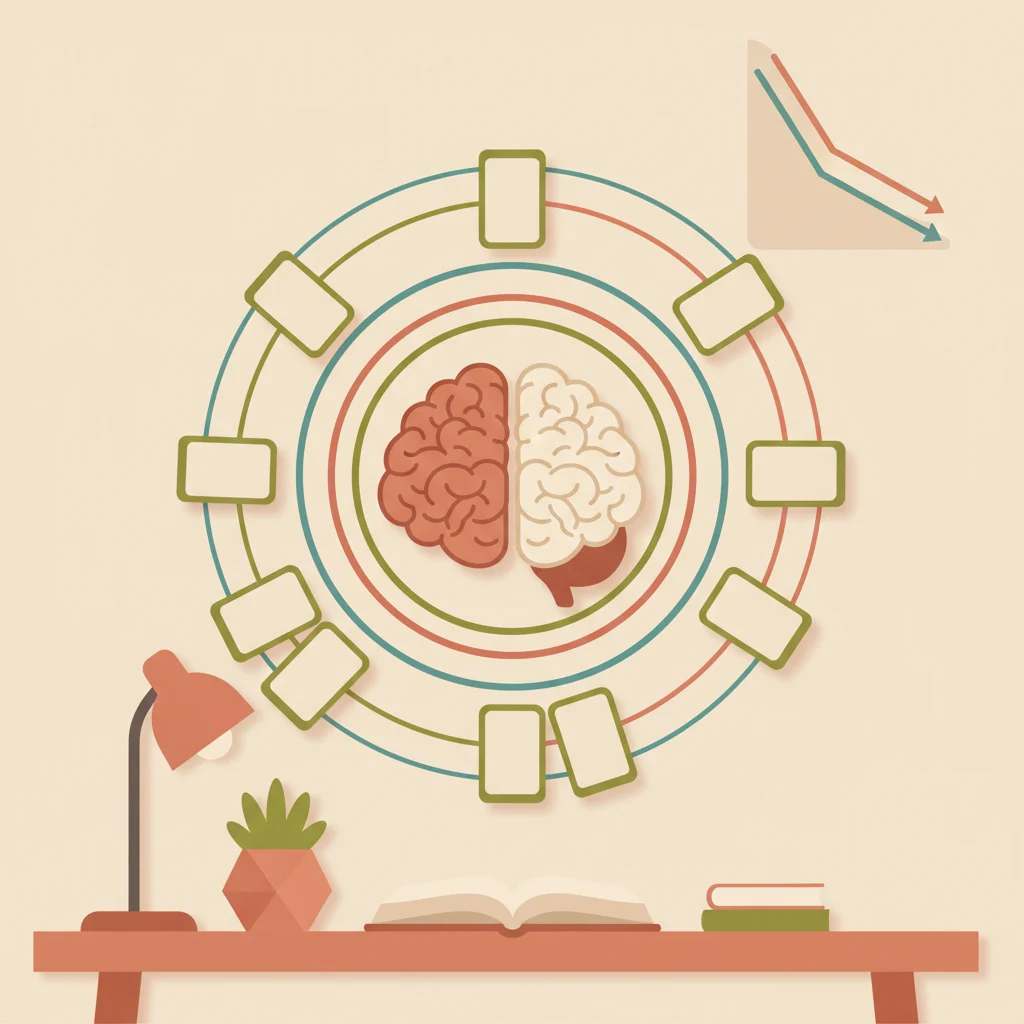
There are two ways to organise a maths revision session. The first, and most common, is called blocked practice: do ten derivative exercises, then ten integral exercises, then ten limit exercises. The second is called interleaving: alternate exercise types within a single session — derivative, integral, limit, derivative, limit, integral.
Rohrer and Taylor (2007) compared these two approaches. Result: interleaving produced significantly higher exam scores, even though performance during the revision sessions themselves appeared weaker (Rohrer & Taylor, 2007).
Why? Because exams mix exercise types. The real competency in maths is not "being able to compute a derivative after ten derivative problems in a row" — it is "recognising that an exercise calls for a derivative when nothing in the question states that explicitly". Interleaving forces you to develop this recognition skill.
How to practise interleaving:
Take exercises from several different chapters and mix them within a single session. Do not finish all the exercises from one chapter before moving to the next. Alternate deliberately.
This feels counterintuitive and sometimes frustrating — you may feel like you are performing worse. That is normal. The additional difficulty is precisely what deepens the learning. See our full guide on spaced repetition and memory.
What to Do When You Are Genuinely Stuck
There is a simple rule: do not stay alone with an impasse for more than 20 minutes.
Twenty minutes of trying to understand something that isn't clicking, with no result, is twenty minutes of accumulated anxiety and frustration. After twenty minutes without progress, change strategy.
Your options, in order:
- Re-read the relevant section of your notes, looking specifically for the missing step. Sometimes you are stuck because you skipped a line of explanation. A targeted re-read of the exact step where you are blocked can be enough.
- Find a different example or explanation. Your notes often give a single type of example. The internet offers dozens of different explanations of the same concept. A different formulation can unlock understanding.
- Ask a classmate. Explaining a block to someone who understands — or trying to describe what you attempted — is often enough to identify where your reasoning went wrong.
- Ask the teacher. Precise questions ("I don't understand why at step 3 we do X") get far better answers than vague ones ("I don't understand anything about integrals").
- Step back. If the block persists after all four steps above, the gap is likely further upstream. Go back to the previous section of your notes, or to the previous chapter.
Isolation in the face of a mathematical impasse is the surest way to turn a manageable gap into a lasting block. Asking for help is not an admission of failure — it is an effective learning strategy.
Maths Without a Calculator: Rebuilding Mental Arithmetic
A common problem among students who have relied on a calculator since secondary school: mental arithmetic has atrophied. They hesitate over simple multiplications, basic fractions, or powers. These hesitations slow down the resolution of complex exercises and occupy working memory that should be available for the structure of the problem itself.
A calculator is a useful tool — but it should not become a cognitive crutch.
To rebuild your arithmetic automaticity:
- Times tables: work on them until they are immediate, not calculated.
- Fractions: addition, subtraction, multiplication, and division of simple fractions, in your head, regularly.
- Powers and simple roots: knowing that 2^10 = 1024 or that the square root of 2 is approximately 1.41 is not superfluous.
- Order of magnitude: be able to estimate whether a result is plausible without a calculator.
These automaticities are not built in a week. They are maintained through regular practice over several weeks. Five minutes of mental arithmetic per day is worth far more than two hours once a month.
FAQ
Can you catch up on three years of maths gaps?
Yes — but with realistic expectations about the time required. Three years of gaps do not close in a month. The method described in this guide (identify the gap, trace back, rebuild in stages) works, but it takes time proportional to the extent of the gaps. What matters: do not try to catch up on everything at once. Choose the gaps that are most blocking for your current programme and fill those first. A targeted, partial rebuild produces more results than an exhaustive attempt that gets abandoned.
Does using a calculator help or hurt your understanding of maths?
Both, depending on how it is used. A calculator helps when it allows you to focus on the structure of a problem rather than intermediate calculations. It hurts when it replaces understanding: if you type an integral into a calculator without knowing what it means, you learn nothing. The practical rule: solve exercises by hand first, check with the calculator afterwards. Never use a calculator to skip understanding — only to verify or speed up.
How do you stay motivated when you understand nothing?
That is the most honest question you can ask. The direct answer: when you genuinely understand nothing, motivation cannot come from the subject matter itself. It has to come from a different starting point — a level where you do understand something, even if that level is below your current programme. Go back to what you can do, even if it means revisiting material from earlier years, and progress from there. Every exercise completed successfully at an accessible level is more motivating than ten failed attempts at a level that is too advanced. Motivation follows competence — not the other way around.
Is it better to redo the same exercises or do new ones?
Both serve a different purpose. Redoing a failed exercise lets you confirm that you have understood the error. Doing new exercises develops the ability to recognise when a method applies in a new context — which is the real competency tested in exams. The ideal practice combines both: redo failed exercises once you have understood the gap, then move to new exercises of the same type to confirm your mastery.
References
- Ashcraft, M. H., & Moore, A. M. (2009). Mathematics anxiety and the affective drop in performance. Journal of Psychoeducational Assessment, 27(3), 197-205. https://doi.org/10.1080/17405620902839079
- Deci, E. L., & Ryan, R. M. (2000). The "what" and "why" of goal pursuits: Human needs and the self-determination of behavior. Psychological Inquiry, 11(4), 227-268. https://doi.org/10.1207/S15327965PLI1104_01
- Dunlosky, J., Rawson, K. A., Marsh, E. J., Nathan, M. J., & Willingham, D. T. (2013). Improving students' learning with effective learning techniques: Promising directions from cognitive and educational psychology. Psychological Science in the Public Interest, 14(1), 4-58. https://doi.org/10.1177/1529100612453266
- Rohrer, D., & Taylor, K. (2007). The shuffling of mathematics problems improves learning. Instructional Science, 35(6), 481-498. https://doi.org/10.1007/s11251-007-9015-8