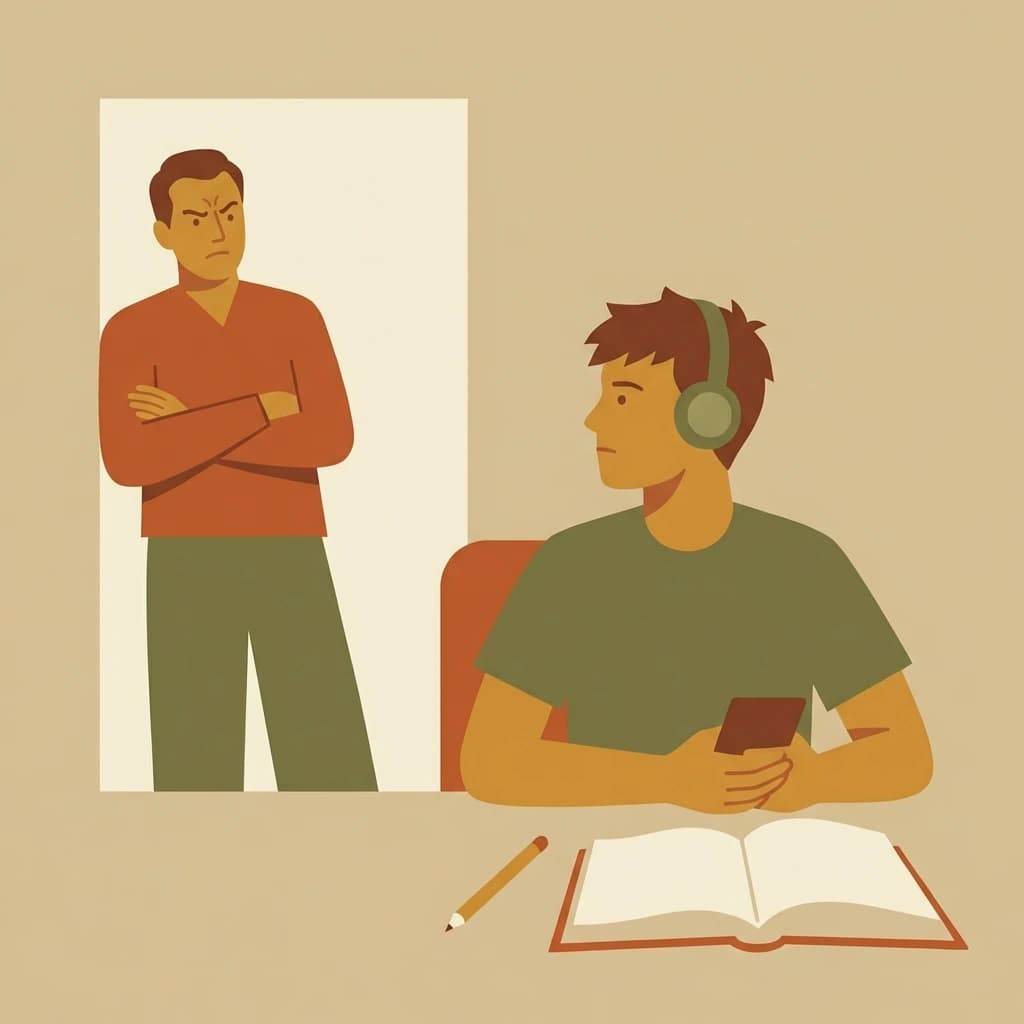
Your high schooler has a quiz Friday and starts studying Thursday night. If this keeps happening, open the class calendar together before the next test is close. Look for a point where work can actually begin: the posted study guide, a returned quiz, or one section of notes. "Study earlier" is too broad to put on a calendar.
Start with the class's next assessment
Check the teacher's assignment page or syllabus with your teen. Is the date firm? What type of work counts: vocabulary recall, an essay, a lab explanation, or new math problems? Ask your teen what they would do in the first five minutes of preparation. If the answer is "I don't know," the starting task needs to be smaller.
A teen may delay because the study guide is unclear, because a previous test went badly, or because other commitments crowd the week. Do not label the cause before asking. Cornell's Learning Strategies Center suggests defining a manageable task and beginning with a small step. One step might be opening the learning platform and writing down the three topics on the test. Another might be answering a single question without notes.
Put a short practice session on an ordinary day
Ask your teen to choose one time before Thursday that fits around school, sports, work, and travel. The task should be specific: "Answer five biology questions from Monday's notes, then check the answers." If there is a second opening, use it to revisit the questions missed. This is a family scheduling agreement, not a promise that a particular number of minutes will raise a grade.
The US Institute of Education Sciences recommends spacing out practice and using retrieval with feedback. That means trying to remember and then checking, instead of reading the same page until it feels familiar. For a writing or problem-solving test, add work in the format the teacher will grade. An app quiz alone cannot substitute for a full essay or multi-step problem.
If Thursday arrives with no earlier practice, pick one useful target for that night. Do not fill it with a fight about what should have happened Tuesday. Protect the time needed for sleep and agree to revisit the pattern once the test is over. The CDC's school sleep guidance lists 8 to 10 hours per day for teens ages 13 to 18 and connects adequate sleep with attention and school functioning.
Ask your teen to own the next step
You can ask, "Do you want help finding the test outline, or would you rather show me your plan after dinner?" They do the practice and decide which question to bring to the teacher. If they repeatedly cannot begin, ask which step is unclear. A school counselor or teacher can help when several classes are affected. For the teen's own view of the problem, this article on starting study when you procrastinate gives a direct routine. For a parent's broader role, see how to help your teenager study.
Wizidoo can turn uploaded class notes into questions and let a student revisit mistakes. A linked parent account can show work completed in the app, but it cannot schedule the next study session or verify school assignments. Use the parent dashboard guide to understand that boundary. If your teen wants to try the questions, explore the parent experience.
Questions US parents ask
Should I schedule every study session for my teen?
Offer realistic openings, then let your teen choose and name the task. A calendar entry they helped make is easier to revisit honestly.
What if the teacher posts the study guide late?
Your teen can review recent class work and ask the teacher what format to expect. Avoid guessing which chapters will appear.
Is one practice quiz before the test enough?
It gives information about gaps. Revisit errors and practice the actual test format when time allows.
How do we fit studying around sports or a part-time job?
Look at the real week, then choose a short opening before the final night. A plan that ignores fixed commitments will fail quickly.
Should homework time count as test preparation?
Sometimes it does, but check whether your teen can do the tested task independently without notes or help.
What if my teen says they work better under pressure?
Ask them to compare a rushed test with one where they had an earlier practice session. Focus on what they could retrieve and apply.
What can we do on the last night without staying up late?
Choose a limited set of questions, correct them, prepare materials, and keep a realistic bedtime. A late night cannot cover an entire course.
How will we know the new routine helped?
Check whether your teen started before the last night, understood their errors, and could answer a similar question later. Grades are one measure, not the only one.
Can Wizidoo plan the dates for us?
No. It prepares course-based questions and records in-app practice. Your teen chooses when to study.
When should I ask school staff for help?
If starting work remains difficult across classes even with a clear, small task, ask a teacher or counselor what they observe at school.