# Exam Stress: A Parent's Guide to Helping
When your teenager is preparing for finals, the stress doesn't stay in their room — it spreads through the entire household. As a parent, you're walking a tightrope: too much pressure and you worsen their anxiety, too little involvement and they feel alone facing the challenge. Research in stress psychology shows that the family environment is a determining factor in how students cope with exam stress. This guide is written for you, the parent, with concrete evidence-based tools.
TL;DR: A child stressed about a major exam needs structure and reassurance, not extra pressure. Concretely: help build a realistic 8-week study plan, reward consistency (30 minutes a day) over cramming marathons, and remind them that the goal is to understand and then test memory (not to reread). Sleep and exercise stay non-negotiable until exam day.
If you're looking for techniques your teen can use directly, see our article on exam stress and how to help your child. Here, we focus on your role.
Understanding Your Teen's Stress: It's Not Laziness
Exam stress is a normal physiological response. Lazarus and Folkman's transactional model (1984) explains that stress occurs when a person evaluates a situation as exceeding their coping resources. For a student facing finals, the stakes are enormous (college admissions, self-esteem, peer judgment) and perceived resources often feel inadequate.
This imbalance manifests in ways parents don't always recognize. Sudden irritability, social withdrawal, sleep disruption, recurring stomach aches, excessive procrastination — these are not signs of laziness or attitude problems. They are indicators of cognitive and emotional overload.
The Yerkes-Dodson law (1908) demonstrates that moderate stress enhances performance, but beyond a threshold, performance collapses. Your job is not to eliminate stress (impossible and counterproductive), but to help your teen stay in that optimal zone where tension is energizing without being paralyzing.
Reference: Lazarus, R. S., & Folkman, S. (1984). Stress, Appraisal, and Coping. Springer.
Warning Signs You Shouldn't Ignore
Before you can help, you need to observe. Some signs are obvious; others are counterintuitive.
Visible Signs
- Sleep changes: difficulty falling asleep, waking during the night, insomnia, or conversely, hypersomnia (sleeping 12 hours a night as an avoidance mechanism).
- Eating changes: loss of appetite, compulsive snacking, skipping meals.
- Disproportionate irritability: explosive reactions to harmless comments, family conflicts intensifying as exams approach.
- Social withdrawal: dropping usual activities, refusing to see friends, isolating in their bedroom.
Less Obvious Signs
- Unproductive hyperactivity: spending hours "studying" without retaining anything, rewriting the same notes, spinning in circles. Your teen looks like they're working, but their brain is in survival mode, not learning mode.
- Sudden perfectionism: starting everything over, nothing is "good enough," refusing to submit work. This isn't rigor — it's anxiety in disguise.
- Constant reassurance-seeking: "Do you think I'll pass?", "Is it normal that I don't know this?" — a need for validation that signals collapsing self-confidence.
- Catastrophic thinking: "I'm going to fail everything," "There's no point," "Everyone else is better than me." These verbalizations signal a cognitive overgeneralization bias you can help them deconstruct.
What to Say (and What to Absolutely Avoid)
Bandura's self-efficacy theory (1997) shows that a person's belief in their ability to succeed predicts performance more powerfully than their actual skills. As a parent, every word you say influences this sense of efficacy.
Phrases to Avoid at All Costs
- "When I was your age, I passed my exams easily." You're minimizing their experience and creating a losing comparison. Today's academic pressure is radically different from what it was 25 years ago.
- "If you'd started studying earlier in the year..." True or not, it's useless at this point. Your teen already knows. Reminding them only adds guilt to anxiety.
- "You don't seem stressed — you're on your phone all day." Compulsive scrolling is a coping mechanism, not indifference. Attacking it removes a crutch without offering an alternative.
- "Finals are nothing, wait until college/real life." Invalidating the current challenge doesn't make it less stressful. It makes it lonelier.
Phrases That Actually Help
- "How do you feel about where you are with your studying?" — An open, judgment-free question that invites dialogue.
- "What would you need to feel more prepared?" — You're helping them identify their own solutions, which builds self-efficacy.
- "I can see you're working hard, that's impressive." — Acknowledge effort, not results. Recognizing effort sustains intrinsic motivation.
- "Exams matter, but they don't define who you are." — You reframe the stakes without dismissing them.
Reference: Bandura, A. (1997). Self-Efficacy: The Exercise of Control. W.H. Freeman.
Creating the Optimal Home Environment
Stress isn't just about thoughts — it's also about context. You have direct control over the physical and emotional environment at home.
The Physical Environment
- A dedicated, tidy study space. Visual clutter increases cognitive load. If your teen studies at the kitchen table between grocery bags and dinner prep, that's a real barrier.
- Reduce intermittent noise. Random noise (conversations, TV, notifications) is more disruptive than constant background sound. If possible, establish quiet hours in the house.
- Natural light. Exposure to natural light regulates circadian rhythms and improves focus. A desk lamp doesn't replace an open window.
- Regular meals. The brain uses 20% of the body's energy. Blood sugar drops impair working memory. Offer balanced snacks rather than waiting for your teen to eat chips at 11 PM.
The Emotional Environment
- Stability and predictability. During stressful periods, family routines serve as anchors. Maintain shared meals, evening rituals, and relaxation time together. Don't turn the house into a permanent study camp.
- Manage your own stress. Teenagers are remarkably perceptive emotional sensors. If you're anxious about their exams, they feel it and interpret it as confirmation that the situation is threatening. Your calm is contagious — and so is your panic.
- Tolerate downtime. Your teen spends 30 minutes on social media between study sessions? That's probably healthy coping. The brain needs breaks to consolidate. Don't turn every moment of relaxation into guilt.
- Avoid comparisons. "The neighbor's kid got straight A's" has never motivated anyone. Every path is unique.
Helping Concretely Without Taking Over
There's a fundamental difference between helping and doing it for them. Bandura's model shows that self-efficacy is built through personal mastery experiences — not through dependency on someone else.
What You Can Do
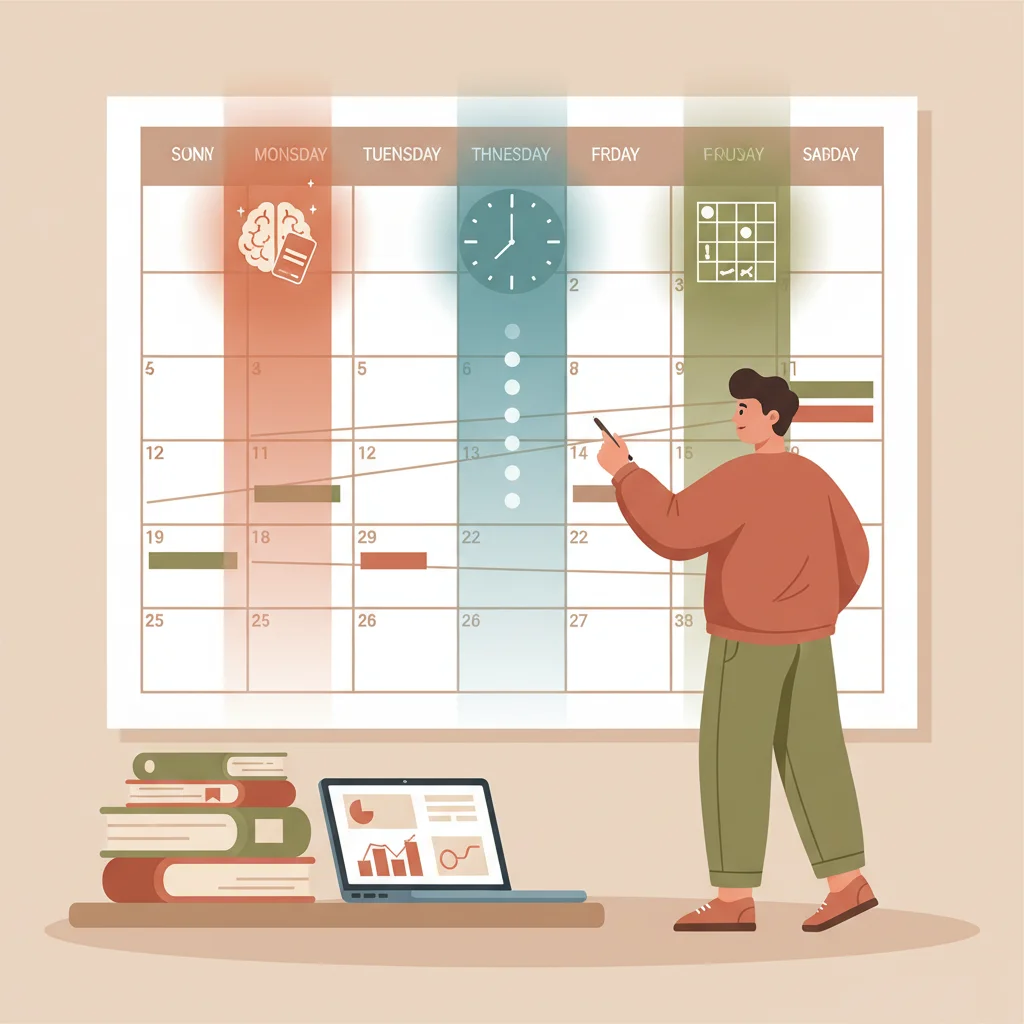
- Help with planning, not studying. You don't need to know the syllabus to help your teen build a realistic schedule. Asking the right questions is enough: "Which subjects do you need to review first?", "How many hours per day do you think is sustainable?"
- Offer to quiz them. Active recall is the most effective memorization technique, and it's something a parent can facilitate without any expertise. Take their flashcards and ask the questions. Check out our article on exam anxiety techniques for more concrete methods.
- Handle logistics. Registration, exam materials, transportation on the day — take everything off their plate that isn't actual studying. Every decision removed frees up cognitive bandwidth.
- Encourage active breaks. Suggest a walk, a movie, a special meal. The brain consolidates during rest. A relaxing evening before exams is often more productive than an all-night study marathon. For more ideas, explore our tips for parents supporting studying.
What to Avoid
- Monitoring study hours. Timing study sessions creates a surveillance dynamic, not a trust dynamic. Managing their own time is a learning experience in itself.
- Checking answers or correcting notes. Unless your teen explicitly asks. Unsolicited interference is interpreted as a lack of trust.
- Imposing your study method. "I used to learn by rewriting everything" — your method may not suit your teen. Everyone has a different learning style.
When Stress Goes Beyond Normal
Exam stress is normal. But there's a threshold beyond which parental support isn't enough. If your teen shows signs of persistent distress — panic attacks, dark thoughts, complete inability to work, severe eating disorders — consult a healthcare professional. The school counselor, family doctor, or a psychologist specializing in adolescents are accessible resources.
Don't underestimate these signals by attributing them to "exam pressure." Untreated chronic anxiety can crystallize well beyond the exam period. If you're unsure how serious the situation is, our guide on the warning signs in your child's grades will help you tell the temporary from the concerning.
Conclusion: Your Calm Is the Best Tool
A parent's role isn't to eliminate exam stress — it's to create an emotional and logistical safety net that allows the teenager to face this challenge with confidence. Observe without judging, support without invading, reframe without minimizing.
Digital tools can also help your teen structure their studying without depending on you. Wizidoo generates adaptive quizzes from their own course materials and automatically identifies weak spots — a way to support the autonomy that Bandura described as the foundation of self-confidence. It's free and can defuse many family tensions around exam preparation.
Exams will pass. Your relationship with your teen stays.
FAQ
How do I know if my teen is too stressed or if it's normal?
Normal stress manifests as occasional nervousness that doesn't prevent functioning. Problematic stress is characterized by persistent symptoms: regular insomnia, frequent crying or anger outbursts, prolonged social withdrawal, repeated statements like "I'm useless / there's no point." If symptoms last more than two weeks and impact daily life (eating, sleeping, relationships), consult a professional.
My teen refuses to study and spends all their time on their phone — what should I do?
Procrastination before exams is often a protective mechanism against anxiety, not laziness. Rather than confiscating the phone (which destroys trust), try opening the conversation: "It seems like it's hard to get started — what's blocking you?" Suggest breaking the work into 25-minute blocks (the Pomodoro method). The key is to reduce the perceived size of the task.
Should I restrict outings and leisure during the study period?
No. Social activities and physical exercise are essential stress regulators. A teenager who runs, sees friends, plays music, and maintains a balanced life studies better than one locked in their room for 14 hours a day. Imposing a deprivation regime creates resentment and exhaustion without improving results. Aim for balance: structured study blocks AND guilt-free downtime.
How do I manage my own anxiety as a parent during exam season?
Acknowledge it first. Your stress is legitimate — you want the best for your child. But your visible anxiety becomes theirs through emotional contagion. Identify your own fears (academic failure, college prospects, social judgment) and separate them from your teen's reality. Talk about your worries with a partner, friend, or colleague — not with your teen. And remember that exams are a milestone, not an endpoint: whatever the outcome, your child will have other opportunities.