# Quizlet Alternative in French: Automatic Quizzes from Your Courses
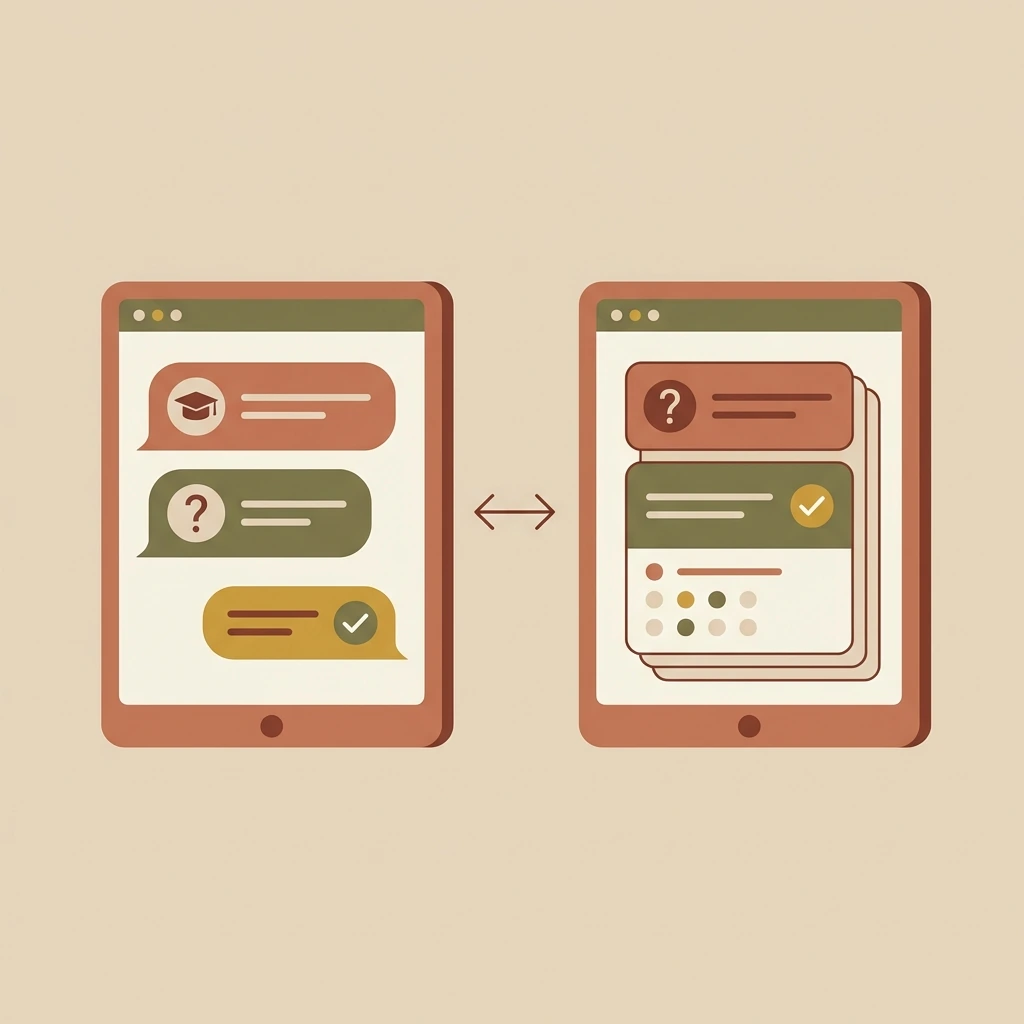
The main difference: with Quizlet, you create your flashcards yourself, term by term; with an alternative like Wizidoo, you import your course (photo or PDF) and the AI generates the questions automatically. Quizlet is an excellent, widely used flashcard tool built on active recall. But it asks you to enter each card by hand, which takes time when you have a whole chapter to revise. If you are looking for an alternative that spares you that data entry, this comparison tells you honestly what each one does best.
TL;DR: Quizlet = flashcards you type by hand, term/definition, in a mature, multilingual interface. Wizidoo = quizzes generated automatically from your imported courses (photo or PDF), with mastery-percentage tracking by chapter. Both rely on active recall, the principle that actually works. Choose Quizlet if you want to control each card and learn vocabulary; choose an auto-generating alternative if you do not have time to type everything and you revise long courses.
What exactly does Quizlet do?
Quizlet is a flashcard platform launched in the United States, used by millions of students worldwide. Its principle is simple and solid: you create "sets" of cards, each with a front (a term, a question) and a back (the definition, the answer). You can then revise these cards in several ways: classic mode, test mode, matching games.
Its great strength is that it relies on active recall. When you see the front and try to remember the back before flipping it, you do exactly what research recommends: retrieve information from your memory rather than re-read it. This is the mechanism Roediger and Karpicke (2006) identified as clearly superior to passive re-reading. On that point, Quizlet does its job well.
Quizlet is also very complete for vocabulary learning, especially modern languages, where the term/translation pair fits the flashcard format perfectly. Its interface is mature, available in several languages including French, and there is a huge library of sets created by other users.
What is Quizlet's limit for revising a course?
Quizlet's main constraint is not in its quality, but in its model: you have to create each card yourself. To revise a fifteen-page biology chapter, you have to extract the important concepts, phrase a question for each, type the front and the back. That is a task in its own right, upstream of the revision.
This creation work has two consequences. First, it takes time, sometimes as much as the revision itself. Many students give up at this stage, or fall back on ready-made sets found online that do not exactly match their course. Second, the term/definition format suits vocabulary well but less so the complex concepts that require understanding a line of reasoning, a mechanism, a chain of causes.
Let us be clear: this is not a flaw in Quizlet, it is its design choice. Quizlet is a manual flashcard tool, and it owns that. The only question is whether this model matches your way of revising. If you enjoy building your cards and have the time, Quizlet is perfect. If you are short on time and want to start directly from your course, an alternative that auto-generates the questions may suit you better.
How does Wizidoo work differently?
Wizidoo starts from the opposite problem: instead of asking you to create the questions, it generates them automatically from your course. You photograph your course or import a PDF, and the AI analyzes the content to produce a suitable quiz. You go straight from "I have my course" to "I am testing myself on it," without the manual entry step.
Concretely, here is how it works:
- You import your course (photo of your notes or PDF file).
- The AI extracts the key concepts and generates a multiple-choice quiz on them.
- You answer, and the concepts you have not mastered (not two correct answers in a row) automatically come back in later quizzes.
- A mastery-percentage score by chapter shows you where you stand and what you have left to work on.
The underlying principle is the same as Quizlet: active recall. You test yourself instead of re-reading. The difference is in how you get there. Quizlet has you build the material, Wizidoo builds it for you from what you already have. For long, dense courses (sciences, humanities), skipping the creation step changes a lot.
Wizidoo also generates summary sheets from the course, and organises your progress in layers, from the most fundamental to the most precise. Where Quizlet focuses on flashcards, Wizidoo covers the move from raw course to revision material.
Try Wizidoo for free at wizidoo.com to turn one of your courses into a quiz and see the difference.
Quizlet vs Wizidoo: the honest comparison
Here are the main differences, without putting either one down. Each has a terrain where it is more relevant.
| Criterion | Quizlet | Wizidoo |
|---|---|---|
| Creating the questions | Manual, card by card | Automatic from the course (photo / PDF) |
| Starting point | A list of terms you type | Your existing course |
| Format | Term/definition flashcards | Multiple-choice quizzes + summary sheets |
| Ideal for | Vocabulary, languages, lists to memorize | Long, dense courses (sciences, humanities) |
| Tracking | Progress on sets | Mastery percentage by chapter |
| Active recall | Yes | Yes |
| Prep time | High (typing each card) | Low (importing the course) |
| Community library | Very large | No (you start from your own courses) |
The right reflex is not to look for "the best" in absolute terms, but the one that fits your use. To learn 200 German words, Quizlet and its term/translation logic are built for that. To revise a biology chapter you do not want to retype card by card, an alternative that generates the quiz from your course spares you the most tedious step.
How do you choose between the two?
Ask yourself three simple questions.
What type of content are you revising? Vocabulary, lists, term/translation pairs? Quizlet is in its element. Written-out courses, whole chapters of sciences or humanities? An auto-generating alternative will save you time.
How much time do you have to prepare your revision? If creating your cards does not bother you and is part of your learning, Quizlet is perfect. If you are short on time and want to test yourself on your course right away, auto-generation is a real gain.
Do you need to track your mastery by chapter? Quizlet shows you your progress on your sets. Wizidoo gives you a mastery percentage by chapter, useful for knowing where to focus when you prepare an exam with many chapters.
And nothing forces you to choose a single tool. Many students use Quizlet for a language's vocabulary and another app to revise their main courses. Both rely on active recall, the principle that really counts. If you want to understand why this technique works, we explain it in active recall, the memorization technique that works.
Frequently asked questions
Is Quizlet free?
Quizlet offers a free version with the basic flashcard functions, and a paid version that unlocks extra modes. The model has changed over time, so check the current terms on their site. The point to keep here is less the price than the way it works: in all cases, you create your cards yourself.
Can Wizidoo replace Quizlet for languages?
For pure vocabulary learning (term/translation, word lists), Quizlet's flashcard format is very well suited and hard to beat. Wizidoo is designed more for revising written, dense courses, where auto-generating quizzes from the content makes full sense. For modern languages, the two can complement each other rather than replace each other.
Is auto-generating quizzes really reliable?
The AI generates the questions from the content you import: the quiz quality therefore depends on how clear your course is. It is a real time saver over manual entry, but it remains a tool: re-read the questions, and use the mastery score to spot the chapters where you need to push harder. Auto-generation does not exempt you from understanding, it just saves you the card-creation step.
Do you have to create your own flashcards to learn well?
Creating your cards has a virtue: rephrasing a concept as a question is already an act of learning. That is the argument in favour of Quizlet. But this effort has a time cost, and many students never finish the creation. Auto-generation shifts the effort: you skip creation to get faster to testing, which is when learning is reinforced most (Roediger & Karpicke, 2006). Both approaches are defensible.
Are there other alternatives in French?
Yes, several revision tools exist, with varied approaches (manual flashcards, spaced repetition, quizzes). We compared several of them in the best revision apps in 2026. The sorting criterion stays the same: do you prefer to create your material yourself or start directly from your existing courses?
References
- Roediger, H. L., & Karpicke, J. D. (2006). Test-enhanced learning: Taking memory tests improves long-term retention. Psychological Science, 17(3), 249-255.
- Dunlosky, J., Rawson, K. A., Marsh, E. J., Nathan, M. J., & Willingham, D. T. (2013). Improving students' learning with effective learning techniques. Psychological Science in the Public Interest, 14(1), 4-58.