You completed every question in your study guide, yet the last page of a practice exam stayed blank when time ran out. The number of unanswered questions is a clue, not a diagnosis. It cannot tell you by itself whether you forgot content, chose a slow approach, misread a prompt, or wrote more than the rubric required.
Decide what the rehearsal should reveal
Pick one question type you expect on the class exam. Look at the syllabus, instructor directions, or a sample rubric. If the test asks for a document-based essay, a timed set of definition cards will measure the wrong task. If it asks for multi-step problems, a quick vocabulary quiz has the same limitation.
Write down what you want to learn from the attempt: Can you select a method? Finish a section? Support a claim with evidence? This makes the later correction useful even if the score is disappointing. An exam readiness check uses more than one signal; this rehearsal focuses on pacing and the work produced within the time available.
Run the task under the actual rules
Choose unused questions that resemble the assessment. Match the time, permitted resources, and format. The Cornell Learning Strategies Center advises students to use the same time and resources as the real exam. If you have approved extended time or another accommodation, include it in the rehearsal. A shorter artificial limit would describe a different test.
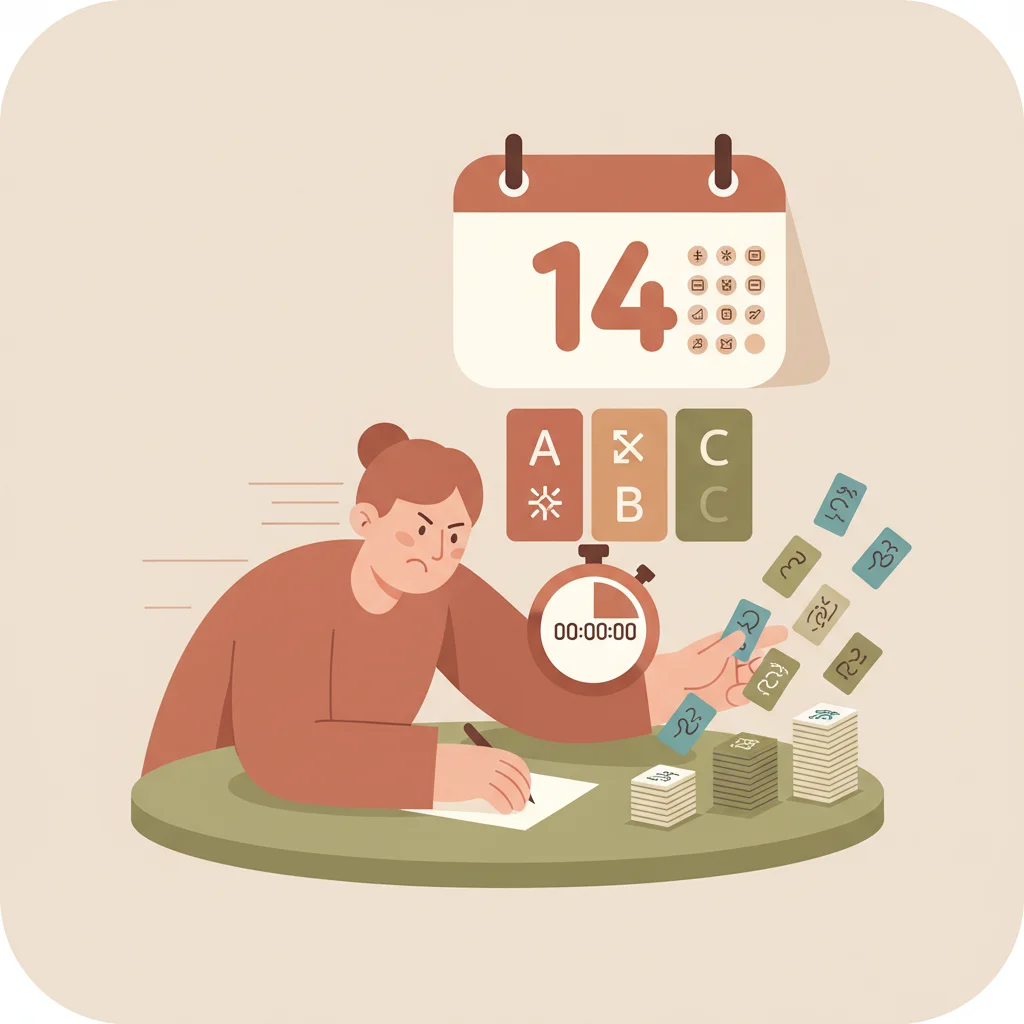
Budget the minutes roughly across the parts, with a little time to check directions. Close notes for a closed-book exam, start the timer, and keep working. If a question stalls you, mark it and move on when the format allows. At the end, record where you stopped before opening the answer key.
Read the work, not just the clock
Compare each answer with the rubric or class solution. A fast finish with thin explanations is not a strong result. A slow but accurate graph interpretation points to a different next step than a forgotten term. Suppose the biology multiple-choice section fits the time limit, but unfamiliar graphs consume twice as long as vocabulary items. Practice new graphs, including what each axis represents, instead of copying definitions again.
For each missed or unfinished item, ask whether you lacked the concept, chose the wrong method, understood the prompt only after seeing the solution, or spent too long writing. Use active recall for a forgotten idea. Compare problem types when method selection is the issue. Ask an instructor about a rubric you cannot interpret. If anxiety repeatedly stops you from working, seek support; one practice score does not predict the final grade.
Make the next attempt smaller and fresher
Work on one specific weakness, then try a new question of the same type under comparable conditions. Repeating a question whose solution you just read mostly measures memory for that solution. You do not need a full-length exam every evening; a short timed section can show whether the change carried over.
Wizidoo's quiz on your own course can help you recall and check a lesson. It does not simulate every class's writing demands, time rules, or grading rubric. You can try one lesson in Wizidoo, then complete a separate task in the format your instructor will grade.
Frequently asked questions
Should I time every study session?
No. First learn the material, then use a few timed attempts to check pacing in the format your course actually uses.
Is a ten-question quiz the same as a practice exam?
Only if the exam is comparable. An essay, lab analysis, or multi-step problem needs practice in that form too.
What if I do not have an official practice test?
Use representative questions from class and confirm the format with your instructor. A random online test may cover different material.
Should I use my notes while practicing?
Follow the real test rules. For a closed-book exam, leave notes closed until you review your attempt.
What if I have approved extended time?
Use it in your rehearsal. A practice test with less time measures a different situation.
Does finishing early prove I am ready?
No. Compare the depth of your answers with the rubric. A short answer can be fast because it is incomplete.
I ran out of time. Should I just write faster?
First locate where the time went. You may need a clearer method, a shorter outline, or better familiarity with the question type.
How many full practice exams do I need?
There is no universal number. A baseline, targeted practice, and a later attempt with new questions can already reveal useful change.
Can test anxiety affect my timed result?
Yes. Record it as one factor, and seek help if anxiety repeatedly prevents you from working. One rehearsal does not predict the final grade.
Do my Wizidoo quiz results predict my exam score?
No. They reflect your answers in the app and cannot measure every skill or timing demand of your course exam.