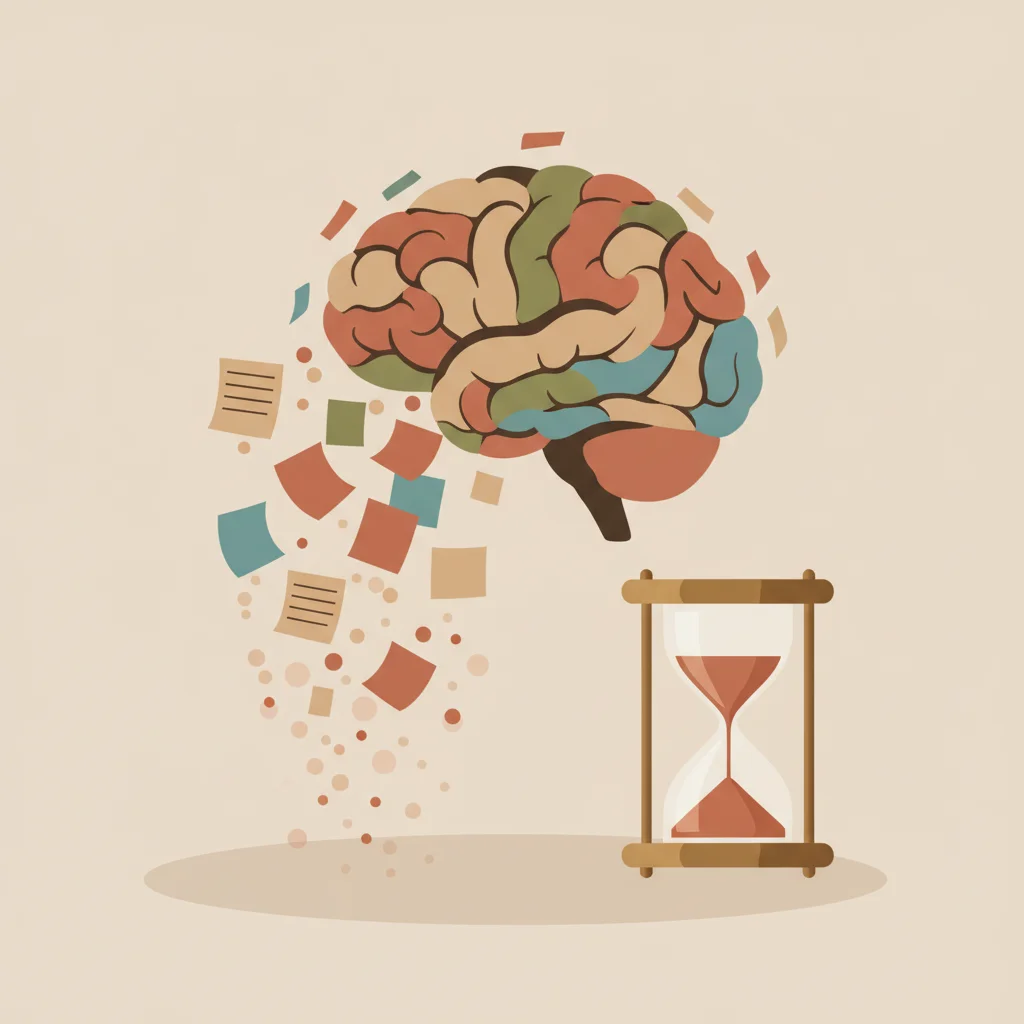
You could explain the lesson yesterday. Today, the first question leaves you searching for words. Forgetting what you study is frustrating, but one difficult attempt doesn't tell you that your memory is broken or that the earlier session was pointless.
Start by looking at what happened between learning the material and trying to use it. Did you understand the explanation? Did you ever answer without looking? Have you tried recalling it after a gap? Those questions point to different next steps.
Familiarity can disappear faster than you expect
When the textbook is open, its headings and examples provide cues. Close it and those cues are gone. A page that felt easy to follow may be harder to reconstruct than you expected.
This is one reason rereading notes is a limited check of learning. It can help you revisit an explanation, but it does not show whether you can produce the answer on your own.
Try a small comparison. Read one section, close it and write down the main idea. Check what you missed. Later, attempt a different question about that idea. The contrast is more useful than judging your memory by how familiar the page looks.
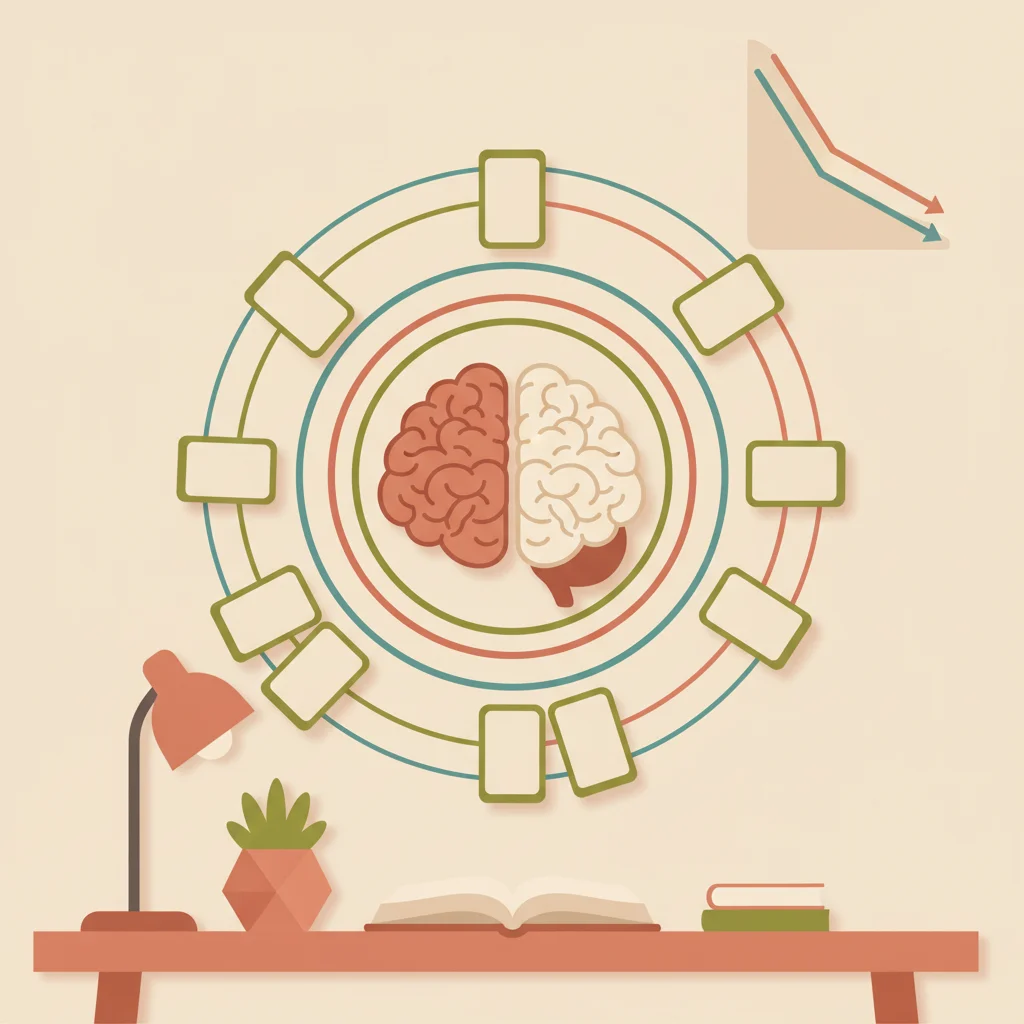
The forgetting curve is not your personal countdown
You may have seen claims that everyone loses a fixed percentage of a lesson after an hour or a week. Those numbers should not be treated as a forecast for your biology notes.
Ebbinghaus's historical work and a later replication by Murre and Dros studied retention under particular experimental conditions. The general point is that recall can decline over time. Your prior knowledge, the material and the way you practice affect what happens in a real course.
A useful response is to plan another encounter with important material, rather than trying to calculate the exact minute at which it will vanish.
Find the kind of difficulty you are having
A wrong answer can have several causes. Use a recent example from class to separate them:
| What you notice | What to try next |
|---|---|
| You recognize the answer but cannot produce it | Attempt recall before reopening the notes |
| You repeat a definition but cannot use it | Work through an example and explain the connection |
| You mix up similar terms | Compare them side by side, then test the distinction |
| You never understood the explanation | Ask the teacher or instructor to clarify the confusing step |
For a U.S. history class, remembering an event's name is different from explaining its significance using assigned evidence. For algebra, recognizing a worked solution is different from choosing a method independently. Practice the task you need, not just the words you associate with it.
Give the correction a second chance to stick
After checking an error, write a short explanation of the correction. Then use a fresh prompt. If you immediately repeat the same answer, you may be relying on having just seen it.
Return on another day. The research review by Cepeda and colleagues supports distributing practice rather than concentrating it all into one session. It does not prescribe a single sequence of intervals for every school subject.
For a Friday unit test, that might mean practicing on Monday and returning to difficult points midweek. For a college final, it means bringing earlier topics back into the plan. Use your actual deadlines; see our spaced study schedule for an example.
Stop treating every blank as a verdict
A missed answer gives you something to investigate. Look at several attempts and at feedback from class before concluding that nothing is working. Keep the note specific: "I confused these two terms" is more useful than "I forget everything."
If the same problem persists despite explanation and practice, ask for help. A teacher, school counselor or college learning center can help you examine the workload and available support. A study article cannot diagnose the reason for an ongoing difficulty.
Don't build a plan that depends on endless late-night catching up. Leave room for rest and realistic commitments. The next useful session is easier to plan when it has a small target instead of a demand to remember the whole course.
Use tracking as a prompt for action
Wizidoo prepares questions from photos or a PDF of your material. You can inspect missed answers and use the per-course indicator to follow practice inside the app. That indicator does not measure every part of your memory or predict the next test grade.
The announced new version adds a course path with cards and questions; check availability. You choose when to return, because the app does not calculate a spaced-repetition calendar. U.S. students get their first 3 complete courses free for life on the English web app.
Frequently asked questions
Does the forgetting curve prove I will lose an exact percentage of my notes after one day?
No, historical curves reflect controlled lab settings rather than an exact timeline for real academic subjects. Retention depends on prior knowledge and practice format, so focus on planning follow-up study rather than calculating minute-by-minute loss.
Why can I understand my textbook during study but fail to answer questions the next day?
Open-book headings and cues generate recognition without preparing you to generate answers independently. Close your notes after reading and attempt to explain or write out the core concept from memory.
What should I do if I forget an answer that I got right last week?
Inspect whether the earlier attempt relied on prompts or nearby hints, review the underlying explanation, and try an entirely fresh question. A single correct response does not make later follow-up practice unnecessary.
Should I reread the entire chapter from the beginning when I encounter gaps?
No, restarting from page one wastes time on concepts you already recall reliably. Test across the unit, locate your exact points of confusion, and target only those weak areas in your next session.
How can I fix the issue when I mix up similar definitions on an exam?
Place the competing terms side by side and explicitly outline what distinguishes them. Then, test yourself by classifying fresh examples rather than reviewing their isolated definitions.
Does spaced repetition require following one fixed schedule of review intervals?
Research confirms distributed study works across subjects, but it does not dictate one rigid timeline. Align your review sessions with real syllabus deadlines, such as revisiting Monday's difficult points midweek before a Friday quiz.
Why is repeating the correct answer right after checking my mistakes ineffective?
Immediate repetition relies on short-term visual exposure rather than durable memory retrieval. Write a brief note explaining the correct mechanism, move on, and test the concept again on a later day.
Can late-night study sessions compensate for falling behind in class?
Relying on late-night catch-up degrades both recall and daytime focus. Break your workload into smaller targets with room for rest, and plan concrete daytime intervals instead.
Does Wizidoo automatically schedule my review calendar or predict my test scores?
No, the app does not calculate a spaced-repetition calendar or forecast test scores. You choose when to return, using the per-course indicator solely to inspect missed questions and guide practice.
What should I do if I keep drawing blanks despite regular review and practice?
An online guide cannot diagnose persistent learning hurdles or individual cognitive challenges. Speak with your teacher, school counselor, or campus tutoring center to review your course workload and identify appropriate academic support.