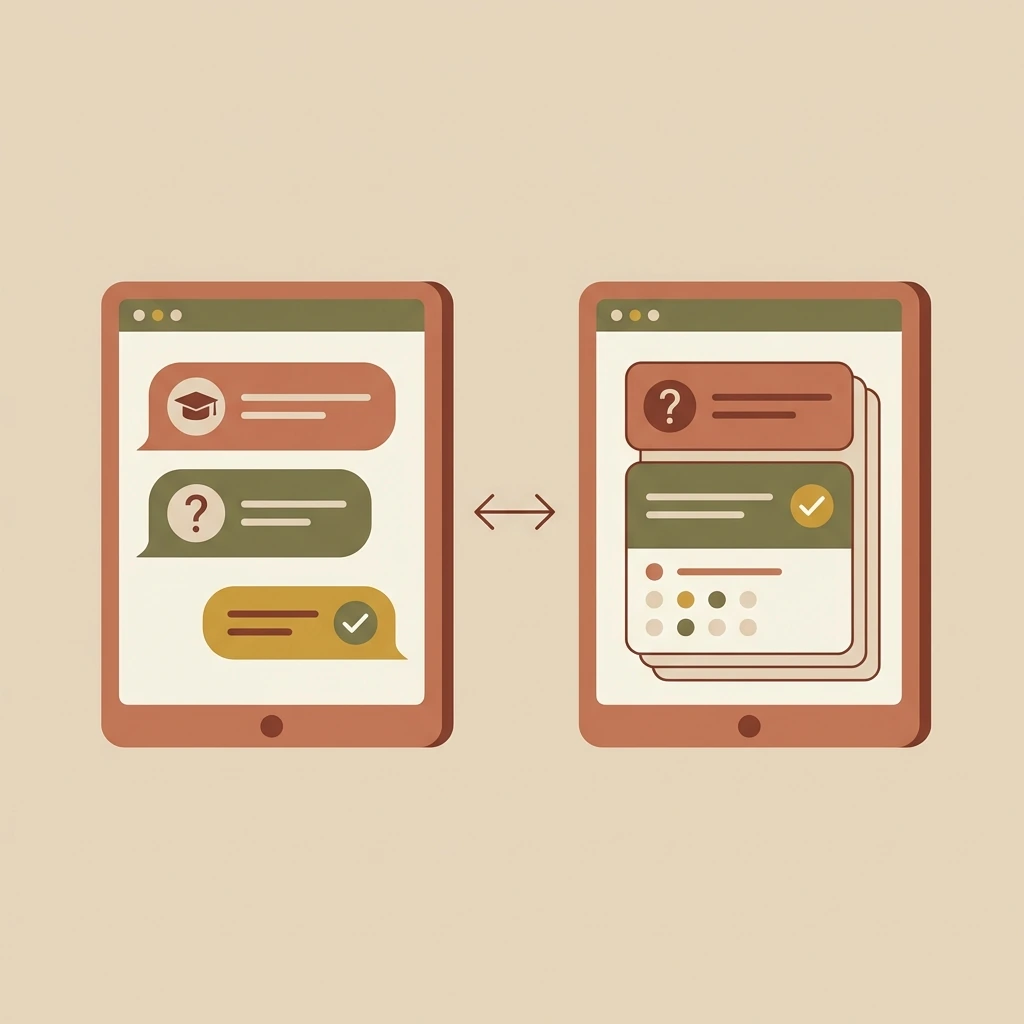
You ask ChatGPT to explain a confusing topic. Then you open a study app to practice it. That can be a useful arrangement, but it isn't the only one: ChatGPT can also ask questions, and study apps differ widely in what they do.
A fair ChatGPT vs study apps comparison starts with a specific job, not a blanket claim that one tool can teach and the other can only test.
What ChatGPT study mode can do
OpenAI's study mode documentation describes guided questions, explanations, practice questions, and work with uploaded materials. With eligible memory settings enabled, it may also personalize guidance using saved memories or past chats.
So it would be inaccurate to say ChatGPT never quizzes you or always starts without context. Its capabilities and limits depend on the current service and your settings. It can also make mistakes.
A useful request is: "Ask me one question about this paragraph, wait for my answer, and help me find the step I'm missing." Check the feedback against the class source.
What to inspect in a dedicated app
Look at how courses and difficult questions are organized. Can you return to a lesson without reconstructing the conversation? Can you find the feedback that mattered last time? What does the progress indicator actually measure?
Don't assume every study app provides spaced repetition. Some calculate card-review intervals; others organize practice without a calendar. Also don't assume a specialized interface guarantees accurate generated content.
Wizidoo prepares questions from photos or a PDF of course material. Wizidoo includes a course path with cards, questions, and review of mistakes. You choose when to return; it does not calculate a spaced-review calendar.
Compare one session fairly
Use a short lesson you can verify. In each tool, attempt a question before reading the answer. After a mistake, inspect whether the explanation helps you identify what to change.
Next, solve a related task without either tool. For a chemistry lesson, that might mean explaining a relationship or completing a calculation with different numbers. Don't compare a fully guided problem in one tool with an unsupported test in another and call the score a product ranking.
Return later and locate the material again. Organization may matter as much as the quality of the first explanation if you need to keep studying several classes.
Consider the parent's role
Wizidoo shows parents course difficulties and, when available, the explanation and advice displayed to their child. That can support a focused conversation about one point to revisit.
It doesn't monitor all homework or establish overall mastery. If family support matters, inspect current parent capabilities directly in each product rather than inferring them from the presence of AI.
Check rules and practical access
Follow your teacher's AI policy and check whether you may upload the materials. Account limits, available tools, and subscription terms can change, so consult the current product pages instead of an old price table.
Wizidoo's web interface supports English; its iPhone app also supports English. The first 3 complete courses are free for life. Premium is annual with immediate payment and no trial period; see current terms.
Choose the workflow you will continue using
A conversation may be useful when you need to explore an explanation. A course-based interface may fit when you want organized practice from your notes. You may need one tool, both, or neither for a particular task.
Try Wizidoo on one course if organized practice is the missing piece. Keep independent exercises and teacher feedback in the plan whichever tool you choose.
Frequently asked questions
Can ChatGPT study mode quiz me effectively instead of just giving answers?
ChatGPT study mode can ask guided questions and wait for your answers, especially when explicitly prompted to guide you step-by-step. You must still verify its feedback directly against your class materials, as incorrect answers remain possible.
Does every dedicated study app provide an automatic spaced repetition calendar?
No, study apps differ widely; some schedule card intervals automatically, while others organize practice sets without calculating a review calendar. Inspect an app's actual features rather than assuming it manages your study timeline.
How does Wizidoo handle review intervals and schedule planning?
Wizidoo generates cards and questions from course photos or PDFs and lets you revisit mistakes, but it does not calculate a spaced-review calendar. You decide independently when to return to the app and repeat your practice.
What will the parent view in Wizidoo's announced update actually display?
The announced version shows parents specific course difficulties and the advice displayed to the student to guide discussions at home. It does not monitor external homework, track overall subject mastery, or replace teacher feedback.
Is ChatGPT's memory feature sufficient to track long-term course progress?
Eligible memory settings can personalize interactions using past chats, but they do not build a structured dashboard of mastered course objectives. You must still organize your notes separately to track which lessons require additional review.
How can I fairly compare ChatGPT and a study app on a single lesson?
Attempt a question from your course in both tools without checking the answer first, then see which explanation better clarifies your mistake. Finish by solving a related problem independently without using either tool.
Is Wizidoo fully accessible in English across mobile devices?
Wizidoo's web interface supports English, but its iPhone app also supports English. Check the current product interface before subscribing if you require English on mobile devices.
What are the pricing terms and trial options for Wizidoo?
Wizidoo offers the first 3 complete courses free for life, while its Premium plan requires an annual upfront payment with no free trial period. Always verify the current pricing terms on the website, as product offerings can change.
What policies should be verified before uploading class materials into an AI tool?
Confirm your instructor's AI policy for the assignment and verify whether you are permitted to upload class documents or copyrighted materials. Always follow your school guidelines before relying on AI-generated explanations.
When is it better to use a chatbot versus a dedicated course app?
Use a conversational chatbot when you need an interactive dialogue or creative analogies to understand an unfamiliar concept. Switch to a dedicated app when you want structured, self-paced practice generated directly from your class materials.