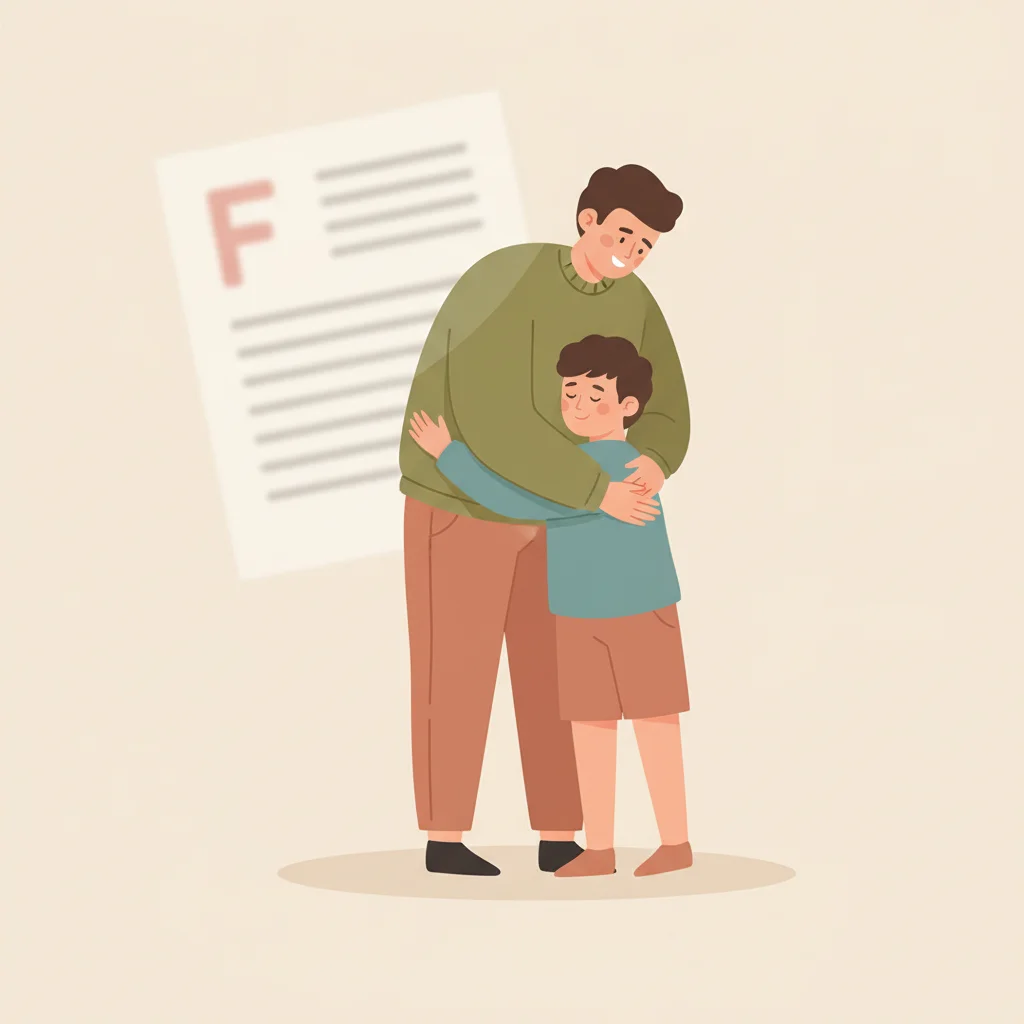
If you are wondering how to talk to your teenager, start by asking whether they want you to listen or help solve a problem. Give the conversation a little room before moving to grades. This guide focuses on school-related conversations, not every cause of distance between a parent and teen.
If your teen shuts down when you ask about school, try a short, specific offer of help at an agreed time. Start with one assignment or question rather than asking for an explanation of every grade. A one-word answer does not tell you why the conversation is difficult or what is happening in class.
Imagine checking a school portal and seeing a missing assignment. Your teen says the portal is wrong. Before the discussion becomes an argument about effort, separate the questions: was the work submitted, does the teacher have it, and is there something your teen needs help completing? You may need information from school before deciding what happened.
## Start with listening before opening the grade portal
Try a moment that is not already occupied by an urgent assignment. You could say, “Would it help to talk, or would you rather I just keep you company?” Let a reply finish before offering a solution. A conversation about something outside school can matter too; every exchange does not need to become a progress check.
If your concern extends beyond schoolwork or you are worried about your teen's well-being, seek appropriate support from a health professional or school counselor. A study app cannot assess that situation. For a specific class difficulty, agree on what information you will check together and what can wait.
## Let the first conversation have a small purpose
You might say, “I saw an assignment marked missing. Can we check what happened after dinner?” That asks for a concrete next step. It leaves room for an administrative delay, a forgotten upload, unfinished work, or a misunderstanding.
If your teen is not ready to discuss it, offer another time rather than adding more questions in the doorway. The aim is not to find a phrase that guarantees openness. It is to make the offer of help clear and give both of you a task you can actually complete.
The Child Mind Institute's advice on communicating with teenagers emphasizes listening and avoiding interactions that become constant lectures. That general advice does not explain every family's situation, and an app cannot infer the cause of a teen's silence.
What a small group of parents told Wizidoo
We reviewed completed answers in Wizidoo's parent onboarding flow on October 5, 2026. After linking responses to eligible accounts and removing identified test accounts, 27 accounts had answers for the questions examined here.
Asked how conversations about school went, 12 selected an option describing an exchange that gets cut short, 6 selected a tense exchange, and 9 selected a discussion. Asked about school follow-up, 10 selected assessment results, 10 selected having nothing concrete in place, and 7 selected regular contact with teachers.
| Reported form of school follow-up | Accounts |
|---|---|
| Assessment results | 10 |
| No concrete system | 10 |
| Regular teacher contact | 7 |
These are selected responses in a commercial onboarding flow. They are not a representative survey of US parents. Country and age were not established for this analysis. The choices shown in the questionnaire influence what people can report, and the sample is small.
We also cannot say that limited follow-up causes difficult conversations. The useful question for a family is more practical: what information would help you offer support before the next report card?
Look at an example together
A grade or missing-work flag can open a conversation, but it may not identify the problem. Ask whether your teen wants help locating the directions, reviewing a concept, or contacting the teacher. Those are different forms of support.
For a middle school student, that might mean checking which part of a worksheet is unclear. For a high school student, it might mean looking at the rubric for a lab report. Use the school's actual instructions, since expectations and portal practices differ between districts and teachers.
If your teen wants to try independently, agree on what help remains available. You can stay nearby without taking over the assignment. Our guide to helping a teenager study offers ways to support the work without replacing the learner.
Give activity data a limited role
Wizidoo can provide information about responses and activities completed in the app. Looking at one of those activities together may be more useful than asking whether your teen “worked enough.” You can ask which question felt unclear and what they tried next.
However, no app activity can account for every paper assignment, class discussion, or task completed elsewhere. No activity in Wizidoo is not proof of no schoolwork. Its results also cannot certify that all homework has been turned in.
Agree on how you will use the information together. A dashboard should support a useful conversation, not silently become a new grading system for the household. Our parent study-support questions cover other situations you may want to discuss.
When school can fill in the missing information
If the same assignment problem continues, contact the teacher with a specific question and involve your teen where possible. For example, ask what would count as a complete submission or which part of the next assessment needs practice.
A teacher or school counselor may have context that the family and an app lack. Keep the question connected to an observed difficulty instead of assuming a reason for your teen's behavior. You do not need to turn a limited quiz result into a conclusion about motivation.
Explore Wizidoo on the web if shared study activity would help your family. The app is also available on the App Store. Its role is to support work on course material; it does not promise to end conflict or replace school communication.
Observation method
Prepared by the Wizidoo team on October 5, 2026. We retained one latest completed response per eligible account and question, linking anonymous-session responses only where a single identified account could be established. Ambiguous account links were excluded. The administrative filter excludes known internal/test accounts and accounts created before March 17.
Only aggregate counts are reported. The responses describe the parents' selections, not independently observed conversations or a clinical assessment. We have not measured whether using a dashboard changed these families' relationships.
Read the full method and download the aggregate counts. Prepared by the Wizidoo editorial team, October 5, 2026. These exploratory observations are not a controlled effectiveness study.
Reader questions
Does refusing to talk mean my teen is hiding a bad grade?
No. Silence alone does not establish that. Start with what you actually know and leave room for another explanation.
Should I stop checking the school portal?
Decide how to use it with your teen. A portal can supply information, but discuss what an entry means before reacting to it.
What if my teen says the teacher has not updated the grade?
Treat that as something to verify. Check the submission record or ask the teacher rather than deciding from the portal alone.
Can I help without knowing the subject?
Yes. You can help find the directions, organize a question for the teacher, or make time for the task.
Should every discussion end with a study plan?
No. Sometimes establishing what happened or listening to an explanation is enough for that conversation.
Is the parent sample American?
The analysis did not establish that. We do not present these 27 accounts as a US parent survey.
Do the counts show that dashboards reduce arguments?
No. This was a description of onboarding answers, without a comparison before and after dashboard use.
Can Wizidoo show whether all homework is done?
No. It records activities within Wizidoo, not the completion of every assignment from school.
What if my teen wants to speak directly to the teacher?
Help prepare the question if needed, and let them take the role they can manage. Follow the school's communication process.
How often should we check in?
Choose a workable arrangement together and review whether it helps. These data do not establish an ideal daily or weekly frequency.